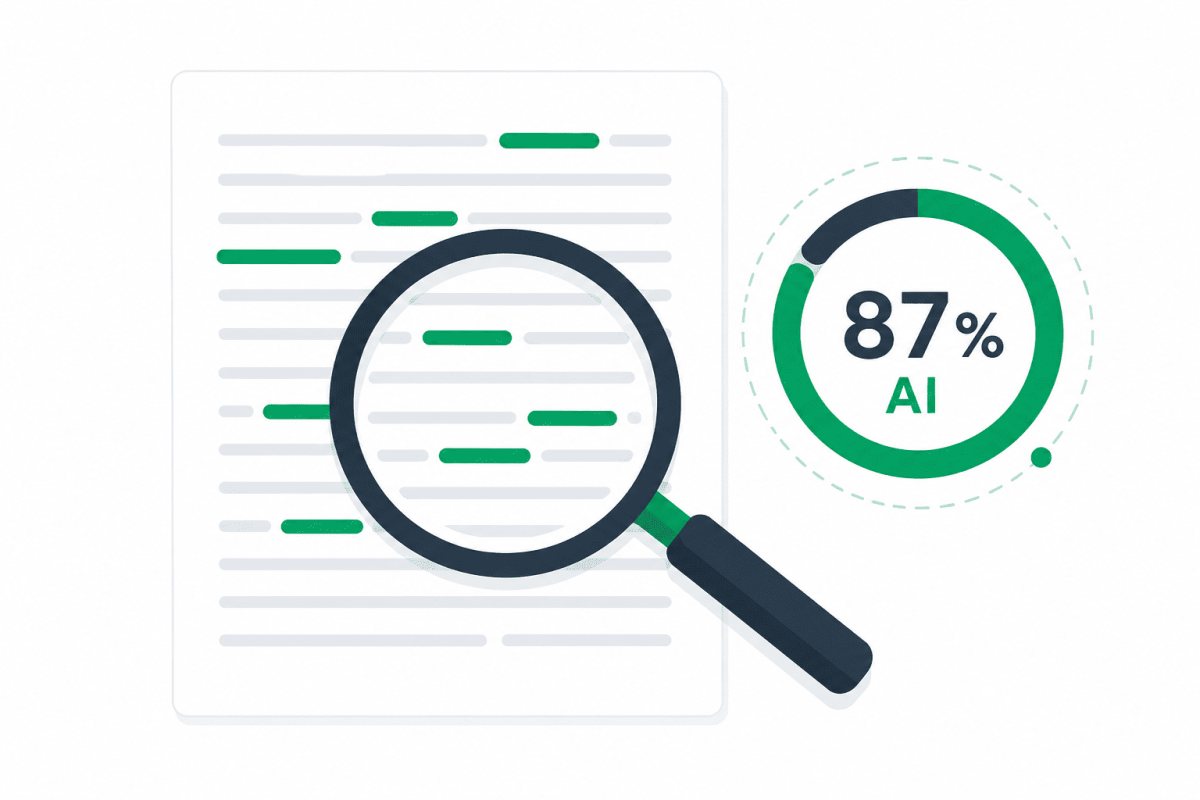
Check if your text was generated by AI in seconds. Get an accurate detection score, sentence-by-sentence analysis, and a detailed breakdown for ChatGPT, Claude, Gemini, and other major AI models.
AI Content Detector
Analyzing...
Scanning for
AI patterns...
0
words
Detection Result
98%
Detection
accuracy
Free
No sign-up
needed
20+
AI models
supported
< 2s
Instant scan
time
Model Coverage
One AI Checker for Every Major AI Writing Tool
You do not need to know which AI tool was used. Our detector is trained on datasets from every leading language model and writing assistant, giving you reliable results in a single scan.
ChatGPT
Gemini
Claude
Llama
Jasper
Chat assistants
ChatGPT (GPT-4o, o1), Claude 3.5, Gemini, Copilot, Perplexity, DeepSeek, and Grok.
Marketing writers
Jasper, Copy.ai, Writesonic, Rytr, and standard AI content generators.
Open models
Llama 3, Mistral, Qwen, and custom fine-tuned or self-hosted models.
Three Simple Steps
How to Check Text for AI in Three Steps
No account, credit card, or download required. Scan any document in seconds.
1
Paste or upload your text
Paste your essay, article, email, or report, or upload a TXT, PDF, or DOCX file. You can check entire documents all at once without breaking them up.
2
Run the AI scan
Click Check for AI. The engine evaluates word predictability, sentence variance, and structural patterns to generate a comprehensive AI probability score.
3
Review your detailed report
View your overall percentage, clear verdict, and sentence breakdown. If the score is higher than desired, easily rewrite flagged passages with our built-in humanizer.
An AI detector is an analysis tool that evaluates text to estimate the probability that it was generated by a large language model rather than written by a human. Instead of searching a database of existing web pages like a plagiarism checker, it analyzes the internal statistical structure of the text and returns a probability score between 0% and 100%.
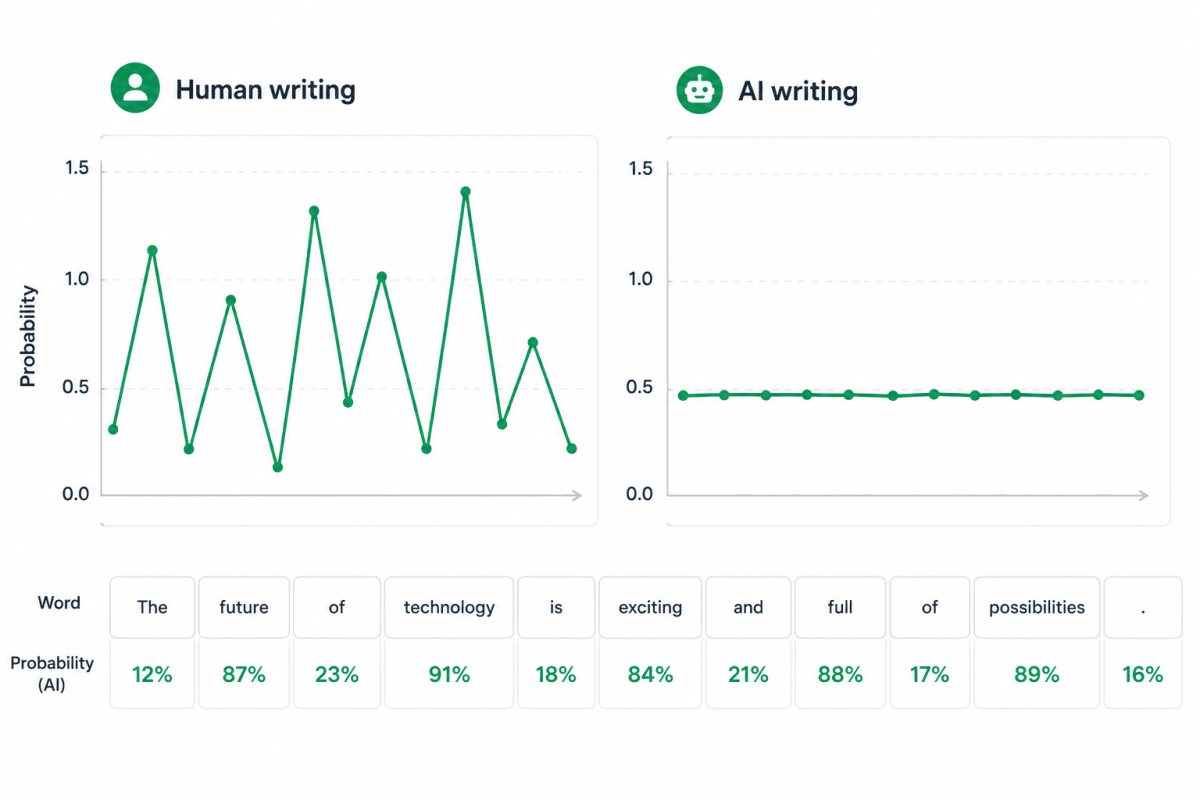
This works because AI models are predictive engines. When generating sentences, a model chooses words with mathematically high probability based on training patterns. Human writers, however, are naturally creative and spontaneous—we vary sentence lengths, use unique phrasing, introduce personal anecdotes, and switch pacing. An AI checker measures this difference between predictable machine patterns and natural human expression.
Not a plagiarism checker.
It does not match text against published web sources; it detects machine generation.
Not absolute proof. A high score indicates strong statistical probability and provides actionable evidence, but should be considered alongside context.
Not a quality score. Highly formal or repetitive human writing can sometimes trigger flags if it lacks structural variety.
Why the score is a probability
Every AI detector calculates a probability percentage rather than a subjective verdict. A document marked
92% AI indicates that its statistical characteristics sit deep inside the range typical of machine-generated text.
Use the score as an objective diagnostic tool to pinpoint exactly which sections need a human touch.
Definition
What Is AI Content Detection?
AI content detection is the methodology of analyzing digital content to identify markers left behind by generative language models. While an AI detector is the tool you interact with, AI content detection is the underlying science of linguistics and statistical modeling.
Principle
one
Detection analyzes how text is structured, not hidden tags
There is no invisible digital watermark embedded in standard AI text. Once text is copied from a chat window, it is simply raw characters. What detection algorithms analyze is the underlying architecture: word choice predictability, sentence length variance, and semantic pacing.
This is why the same AI checker can accurately score text from models it has never specifically encountered. Different models are trained on distinct datasets, but they all optimize for the same objective: predicting the most statistically probable next word. The detectable signature is the mathematical optimization itself.
Principle
two
Longer documents provide more reliable results
Statistical analysis thrives on sample size. In a short 30-word snippet, human writing and machine writing can look almost identical because there is not enough linguistic variation to measure. Across 300 to 1,000 words, true patterns emerge—human writing naturally varies in density, tone, and pacing, while AI text tends to maintain an unnaturally uniform cadence.
150+words for a reliable
reading
300+words for maximum
precision
Principle
three
Detection evolves alongside new AI models
As newer generative models are released, their phrasing and syntax become increasingly sophisticated. Reliable detection requires continuous retraining on fresh datasets. We regularly update our models against the latest outputs from GPT, Claude, Gemini, and open-source models to keep accuracy sharp.
Under The
Hood
How Does AI Detection Work?
Modern AI detection relies on a multi-layered approach rather than a single metric. By cross-referencing multiple linguistic and statistical signals, our engine delivers a balanced and highly reliable assessment.
Here is what our detection engine evaluates when you scan text in the tool above:
Perplexity: Word Predictability
Perplexity measures how predictable each word choice is given the preceding context. Because AI models are trained to pick the most statistically likely next word, low perplexity across a whole document is a strong machine indicator.
What raises it naturally
Specific names, original data, domain terminology, regional phrasing, and personal arguments that a cautious AI would not volunteer.
Burstiness: Sentence Variety & Rhythm
Human writing is naturally bursty. A thirty-word detailed sentence is often followed by a four-word punchy one. Machine text tends to settle into a uniform sentence length. Measuring length and clause variance reveals that uniformity.
What raises it naturally
Sentence fragments, rhetorical questions, varied punctuation, and alternating between concise and elaborate thoughts.
Deep Learning Classifiers
Alongside statistical measurements, we employ transformer classifiers trained on extensive paired datasets of human and machine writing across academic, editorial, technical, and conversational registers.
Why register matters
A research paper and a personal blog post follow completely different conventions. Context-aware models prevent false positives on formal writing.
Stylometric & Structural Analysis
This layer analyzes structural habits rather than isolated words—such as overusing predictable transition phrases, perfectly balanced list items, and conclusions that rigidly restate the introduction.
Common giveaways
Cliche openers like "In today's fast-paced world", excessive hedging, and repetitive paragraph transitions.
How the four signals combine into one score
Each analysis layer produces an independent confidence score. These scores are weighted according to document length and style, then combined into the overall percentage shown in your results. When a document contains both human and machine writing, the score falls in the mixed content band, helping you pinpoint exactly which passages need attention.
Your Result
How to Read Your AI Score
The score represents an AI probability percentage, not a grade. Here is what each score band means and what action we recommend taking.
AI score
Verdict
What it usually means
Suggested action
0 to 19%
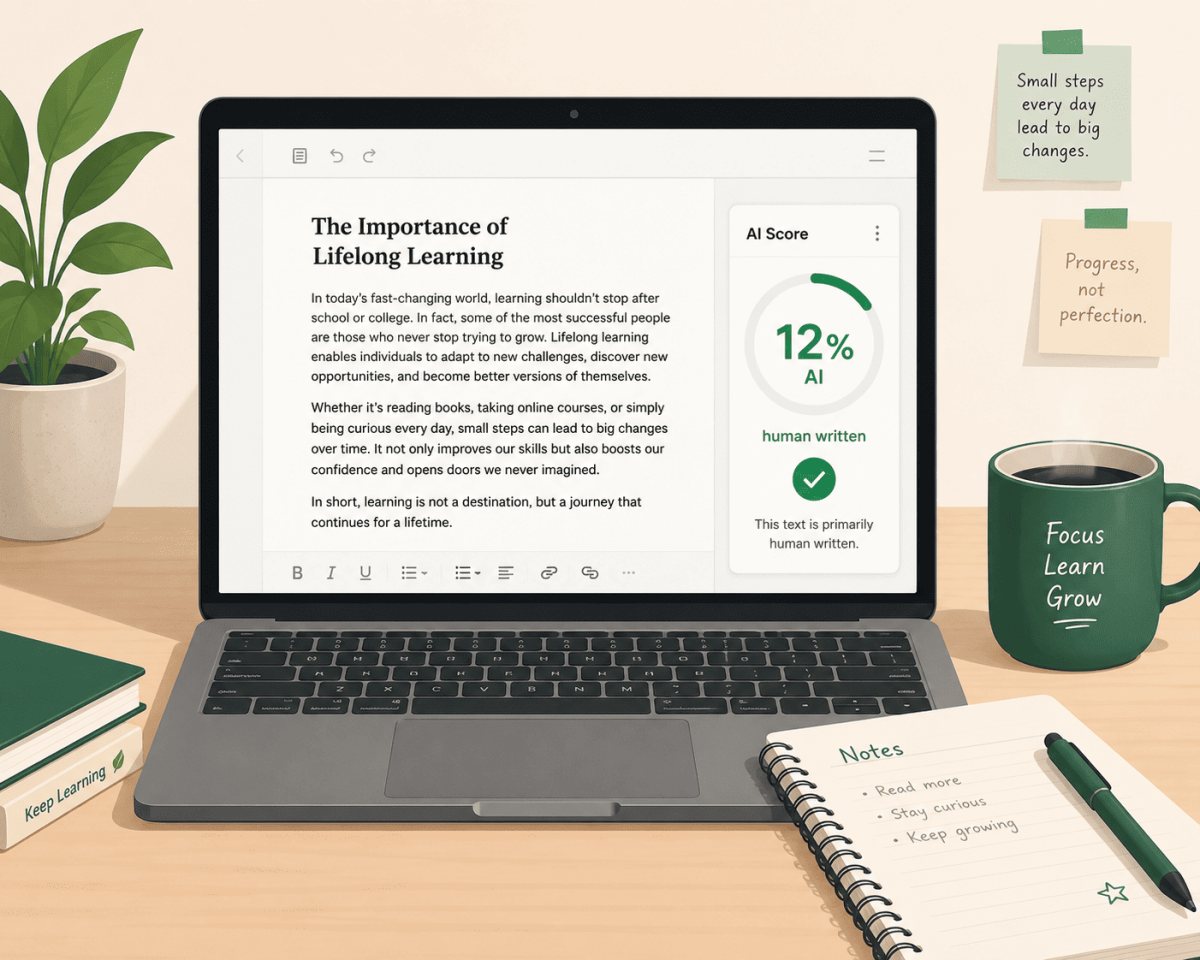
Human written
Varied rhythm, specific details, and authentic voice. Reads naturally as human writing.
Ready to publish or submit. No changes needed.
20 to 39%
Mostly human
Authentic human writing with a few standard or formal phrasing patterns.
Safe in almost all contexts. Optionally loosen up rigid sentences for extra natural flow.
40 to
60%
Mixed content
A blend of human and machine signals. Often occurs when human drafts are expanded by AI, or AI drafts are lightly edited.
Review highlighted passages, add personal examples, and rescan.
61 to
79%
Likely AI
Predictable phrasing and uniform sentence structure across most of the document.
Substantial rewriting or humanization recommended before submission.
80 to 100%
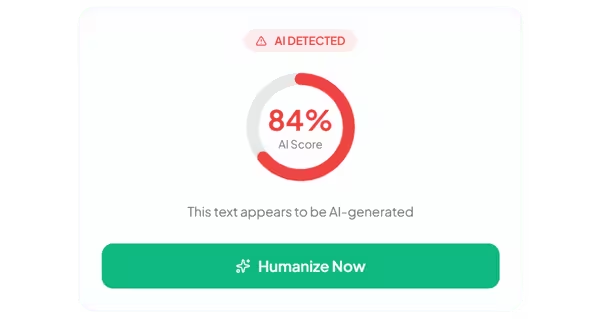
AI generated
Strong machine patterns detected across all analysis layers. Other detectors will reach similar conclusions.
Rewrite thoroughly with original examples, personal voice, and varied syntax.
Total words
Total word count evaluated during the scan.
AI words
Word count sitting inside passages identified as machine-written, showing you where to focus your edits.
Verdict line
A clear, plain-language summary ready to share with clients, editors, or educators.
Who It Is For
Who Uses an AI Detector?
Designed for writers verifying their own drafts and professionals reviewing incoming submissions.
Students and researchers
Ensure your essays, dissertations, and research papers do not trigger false flags before submitting to Turnitin, Canvas, or university portals.
Essays, theses, and lab reports
Personal statements and admissions essays
Protection against false positives for non-native writers
Teachers and academic staff
Get a clear, objective second opinion when coursework appears detached from a student’s typical writing style, opening constructive dialogue.
Quick screening of assignments and papers
Cross-check institutional detector reports
Compare against earlier student writing samples
Content and marketing teams
Verify that freelance writers and agencies deliver original, high-value writing that protects your brand voice and editorial integrity.
Vet freelance and agency deliverables
Maintain consistent editorial quality
Integrate an objective review standard
SEO and publishing teams
Keep content libraries aligned with search engine guidelines by ensuring articles feature authentic, first-hand expertise and natural flow.
Audit large content libraries quickly
Identify formulaic pages that need human depth
Strengthen first-hand experience signals
Recruiters and hiring managers
Screen take-home writing assignments and cover letters to evaluate a candidate’s genuine communication skills and thought process.
Evaluate take-home writing tasks
Review cover letters and candidate prompts
Verify consistency across candidate samples
Developers and platform teams
Moderate user submissions at scale. Our
detection API provides fast, programmatic access to the same high-accuracy engine.
Moderate user-generated content
Filter automated bot and spam submissions
Clean JSON responses for easy integration
The Stakes
Why AI Content Detection Matters Now
With generative text everywhere, knowing whether a piece was handcrafted by a human is essential for credibility, rankings, and trust.
Search performance
Google rewards content featuring genuine expertise and first-hand insights, while generic AI drafts struggle to rank.
Academic integrity
Universities actively use automated screening tools. Scanning your draft beforehand helps prevent misunderstandings.
Editorial investment
Ensure paid freelance work is genuinely handcrafted rather than copied straight from an AI prompt.
Reader trust
Readers quickly recognize repetitive machine patterns. Authentic human voice builds lasting trust and engagement.
Key Differences
AI Detector vs Plagiarism Checker
These tools answer fundamentally different questions, and a document can easily pass one while failing the other.
Question
AI detector
Plagiarism checker
Primary question
Did an AI model write this?
Was this copied from an existing source?
Core method
Statistical and linguistic analysis of the text itself
String and keyword matching against indexed databases
Result format
AI probability percentage (0% to 100%)
Similarity percentage with matching source URLs
Catches fresh AI text
Yes
No, the generated text is newly synthesized
Catches copied web text
Not if it was originally human-written
Yes, identifies matched URLs
Provides source links
No (analyzes syntax without indexing sources)
Yes, links directly to matching articles
This is why a newly generated ChatGPT essay can score 0% on a plagiarism checker yet still be flagged. The words are newly arranged, so no source matches exist, but the underlying syntax is distinctly machine-generated. For complete verification, both checks are valuable.
Academic
Will Turnitin and School Checkers Flag My Text?
Turnitin, Canvas, and other university platforms run AI writing indicators alongside similarity reports. They evaluate the same family of statistical signals used by our checker, which is why a clean score here provides strong confidence for your academic submissions.
What academic AI indicators report
Institutional systems typically report an overall percentage estimating how much of a submission appears machine-written. Crucially, the score alone is not a finding of misconduct. Most academic policies require instructor review, draft history verification, or a discussion before any formal decision is reached.
Best practices before submitting
Scan your entire document rather than isolated paragraphs for the most accurate reading.
Include specific course references, original data, and personal reflections to naturally increase burstiness.
Keep draft histories and research notes as documentation of your genuine writing process.
Follow your institution’s stated AI policy, declaring AI assistance when required.
Avoid tab-switching interruptions. With our free browser extension, you can check text inside Google Docs, Gmail, Notion, WordPress, LinkedIn, and university portals. Highlight any passage, right-click, and select Detect AI.
Right-click detection
Highlight text on any page to view instant detection scores without leaving the tab.
Instant rewriting
If a passage flags high, humanize and rewrite the text right from the context menu.
Convenient sidebar
Keep scan scores, history, and word counts visible beside your draft as you edit.
Works everywhere
Google Docs, Gmail, Slides, Notion, WordPress, and major learning platforms.
A high score is straightforward to fix. Here is the recommended step-by-step process:
1
Identify the flagged passages
Review the AI words count and highlighted sentences in your results. Often, only an introduction or specific formulaic paragraphs need adjustment rather than the entire document.
2
Add original details and firsthand insights
Include specific data points, personal observations, process challenges, and nuanced viewpoints. Concrete particulars raise perplexity and authenticity faster than simple synonym replacements.
3
Break the rhythmic uniformity
Vary paragraph and sentence lengths. Combine short, punchy statements with descriptive clauses, and remove repetitive transition phrases like "Moreover" or "In conclusion".
4
Use the humanizer for fast restructuring
If extensive rewriting is required, our
AI humanizer
restructures flagged text with natural pacing and varied vocabulary while preserving your exact meaning and facts intact.
5
Rescan to confirm
Run the revised text back through the checker. Aim for the human-written range rather than fixating on zero percent, as natural human writing naturally scores between 0% and 20%.
Scanning single articles is easy via the web tool. For larger volumes, paid tiers unlock batch uploads so you can process entire folders of documents in a single pass and export detailed score reports.
For seamless platform integration, our REST API delivers overall probabilities, sentence-level scores, and word metrics in JSON format. Marketplaces, review sites, and publishing teams integrate it directly into their CMS and moderation pipelines.
Your text is processed in real time solely to calculate your score. We never publish, sell, store, or use your submitted content to train public AI models. All transmissions are secured with end-to-end encryption.
You can scan text completely anonymously without creating an account. For confidential manuscripts, client work under NDA, or internal documents, consult our full privacy policy for complete terms.
Essential terminology found in detection reports, academic policies, and AI research.
AI probability score
The headline percentage indicating how strongly the text resembles patterns typical of machine generation.
Perplexity
A measurement of how predictable word choices are in context. Low perplexity signifies highly predictable, machine-like writing.
Burstiness
The degree of variation in sentence length and structure. Human text naturally fluctuates, whereas AI writing maintains steady pacing.
Transformer classifier
A neural network model trained on labeled paired datasets of human and AI text to detect subtle linguistic patterns.
False positive
When human writing is mistakenly flagged as AI. Scanning longer, complete passages is the most effective way to prevent this.
False negative
When machine-written text is identified as human-written, most common with short snippets or thoroughly edited drafts.
Mixed content
A score in the 40% to 60% range where human and AI signals overlap, typically indicating collaborative or partially edited writing.
Digital watermarking
An embedding technique where a model subtly biases token selection for future identification. Easily altered by rewriting.
Text humanizing
The process of rewriting AI text to introduce natural phrasing, varied syntax, and authentic rhythm. See our
humanize AI text guide.
Stylometry
The statistical study of linguistic style and word usage patterns, serving as a core foundation of modern content analysis.
Real Feedback
What People Say About the Ninja AI Checker
Trusted by students, educators, and content professionals worldwide.
Marcus Bennett
MSc Student
"I write all my own assignments but use AI for brainstorming. Checking my work here gives me complete peace of mind before submitting to my university portal. Fast, accurate, and super easy to use."
Aisha Rahman
Content Lead
"We publish dozens of articles each month from freelance contributors. Running submissions through this detector is now standard in our QA process. It helps us keep our editorial standard consistently high."
Tom Whitaker
College Instructor
"The confidence score breakdown is great because it avoids simplistic all-or-nothing conclusions. It provides clear, actionable data that helps me guide students constructively."
FAQ
AI Detector Questions, Answered
Common questions about AI detection accuracy, scoring bands, and best practices.
Our detector delivers an accuracy rate of approximately 98% on documents of 150 words or more. It is benchmarked against paired human and AI datasets spanning academic essays, journalism, creative writing, and technical reports. Longer samples provide the richest statistical signals, which is why scanning an entire document yields the most reliable results.
Yes, 100% free. You can scan text without creating an account or providing credit card details. Optional paid plans are available for users who require higher daily limits, batch file processing, or API integration, but the core AI detector is completely free.
It detects text generated by ChatGPT (including GPT-4o and o1), Claude, Gemini, Microsoft Copilot, Perplexity, DeepSeek, Grok, Llama, Mistral, and writing assistants like Jasper and Copy.ai. Because detection analyzes underlying mathematical and statistical patterns rather than fixed signatures, it also recognizes newly released models.
Yes. Turnitin includes an AI writing indicator alongside its similarity report, evaluating the same statistical predictability and sentence variance signals used by our detector. While a clean score here is a strong indicator of natural writing, we recommend keeping draft histories and following your institution’s academic policies.
A plagiarism checker searches published databases to see if your text matches existing web sources. An AI detector evaluates the internal structure of the text to determine if it was synthesized by an AI model. Fresh AI output will score 0% plagiarism because the words are newly generated, but it will still be recognized as machine-written by an AI detector.
Original human writing can sometimes be flagged if it is unusually uniform, heavily structured around formulaic templates, or excessively smoothed by grammar correction tools. To lower an artificial score, introduce personal anecdotes, vary your sentence lengths, incorporate domain-specific details, and scan larger sections of text.
A minimum of 50 words is required for a basic scan, but we recommend 150 to 300+ words for high-confidence results. Statistical analysis thrives on volume, so full paragraphs and complete articles produce much more definitive scores than single sentences.
Simple surface edits—such as swapping a few synonyms—rarely fool modern detectors because the underlying sentence rhythm and pacing remain unchanged. To properly humanize AI text, you need substantive restructuring: mixing sentence lengths, adding original insights, and varying vocabulary. You can also use our built-in AI humanizer to automate this process.
A mixed content score (typically 40% to 60%) indicates that parts of your document read as human-written while other sections exhibit machine patterns. This frequently happens when an outline or draft created by a human is expanded by an AI, or when AI text is partially edited. Check the highlighted sentence breakdown to isolate and refine the flagged sections.
Yes. You can upload TXT, PDF, and DOCX files directly into the tool. The text is automatically extracted and analyzed within seconds. Paid tiers also support bulk file uploads for scanning multiple documents simultaneously.
No. Your text is processed in real time solely to generate your detection score. We never publish, sell, store, or use your submitted content to train public AI models. All data transfers are protected with end-to-end encryption.
Google focuses on content quality and helpfulness rather than the method of production. However, unedited AI content often lacks unique first-hand experience, original data, and depth—qualities essential for high search rankings. Scanning your drafts ensures your articles read with the authenticity and nuance that search engines reward.
Yes. With our free browser extension, you can highlight text on any webpage—including Google Docs, Gmail, Notion, WordPress, and learning management systems—right-click, and select "Detect AI" to view instant results without switching tabs.
Yes. We provide a high-performance REST API that returns overall AI probabilities, sentence-by-sentence breakdowns, and word-level metrics in JSON format. It is designed for seamless integration into CMS platforms, submission portals, and moderation workflows.
The Complete Guide to AI Detectors and Content Checkers
AI detectors have become standard tools across education, digital publishing, and professional communications. They are integrated into university portals, editorial review workflows, and client sign-offs. However, as adoption has surged, understanding how detection works and what scores indicate has become critical.
This guide covers everything you need to know: how detection algorithms operate, what factors influence accuracy, how to interpret probability scores, and how to write authentic content that naturally passes an AI check.
Using AI as a brainstorming assistant is widely accepted; the challenge arises when unedited machine outputs are published without personal insight or human refinement. An AI detector provides the objective feedback needed to ensure your writing remains authentic.
Why AI detection has become essential
When creating thousands of words takes only seconds, the sheer volume of automated content increases exponentially. In response, search engines look for genuine first-hand experience, educational institutions ensure assessed work reflects real student understanding, and businesses verify original thinking in candidate submissions.
Readers have also grown accustomed to the predictable cadence of AI prose: sweeping generalizations, balanced three-part lists, and cautious conclusions. Detecting and polishing these patterns before publication ensures your audience stays engaged and trusts your message.
An AI detector is just as valuable for self-review as it is for evaluation. Writers use it to catch flat paragraphs before publishing, while reviewers use it to ensure quality standards.
How accurate are AI detectors?
Accuracy largely depends on sample size. On full documents of 150 to 300+ words, modern AI checkers correctly identify content bands with approximately 98% accuracy when benchmarked against paired human and machine datasets.
Scanning short snippets of under 50 words provides less statistical confidence because there is insufficient text to measure rhythm and word predictability. For the most dependable results, scan complete paragraphs or full articles all at once.
Document type also matters. Highly structured texts like legal clauses or lab reports naturally follow strict templates. Advanced detectors adapt their baselines to the document format to minimize false positives on formal writing.
Key features of a reliable AI checker
Four core capabilities distinguish a reliable detection platform:
Multi-signal analysis
Evaluating predictability, sentence variance, deep learning classifiers, and stylometric patterns together prevents evasion tactics and false results.
Contextual register adaptation
Technical abstracts and personal blog posts follow different rules. Context-aware models evaluate each register accurately.
Continuous model retraining
Language models evolve rapidly. Continuous retraining against the latest GPT, Claude, and Gemini releases keeps detection accurate over time.
Sentence-level diagnostics
Rather than just providing an overall number, pinpointing specific flagged sentences shows you exactly where to focus your revisions.
Building AI detection into your team workflow
For teams managing high content volumes, establishing a clear process ensures consistent quality:
Define objective thresholds in advance. For instance, treat scores below 30% as clear, scores between 30% and 60% as requiring review, and scores above 60% as needing humanization.
Share guidelines openly with contributors. Clear expectations encourage writers to incorporate personal voice and unique data before submitting.
Perform checks early in the drafting process. Catching issues during initial reviews saves time compared to revising final proofs right before deadlines. For automated publishing, the
detection API integrates directly into CMS workflows.
Track trends over time to identify whether specific topics or contributors consistently need coaching on incorporating original research.
How to write content that passes AI detection
The most effective way to clear an AI check is to write with genuine human depth and individuality:
Incorporate unique specifics: real metrics, named examples, personal observations, and direct case studies. Particulars are the clearest indicators of authentic human writing.
Express strong, reasoned perspectives. AI text hedges by default to find safe averages. Taking a clear, decisive stance reflects genuine human thought.
Vary your sentence pacing. Alternate between short, punchy statements and longer, complex explanations. Natural rhythm variation eliminates artificial uniformity.
Keep authentic conversational nuances: parentheses, rhetorical questions, and occasional sentence starters like "And" or "But".
Free AI detector vs paid AI checker
For individual checks, our free AI detector delivers the same high accuracy as paid tiers. The core detection engine evaluates every scan with identical precision.
Paid plans offer higher daily limits, bulk file uploads for scanning hundreds of documents, and full API access for automated publishing pipelines.
If you check individual articles periodically, the free tier is ideal. If your organization reviews content daily, paid features streamline the entire workflow.
If your text flags higher than expected and you need fast rewriting assistance, our integrated
AI humanizer is ready to help.
Explore Related Tools
Looking to humanize flagged text or add browser integration? Explore these resources.
Free, fast, and accurate AI detection with no account required. Find out what educators, editors, and clients will see, and refine your writing with confidence.